It is 7pm. The evening aide is standing in the doorway with her coat still on, and you have about four minutes before you need to leave. You say "she's been good today, dinner's in the fridge" — and you drive away. At 9:40pm you get a text asking whether your mother already had her evening pill.
Nobody in that exchange did anything wrong. The handoff just carried almost no information. In hospitals this is a known and heavily studied failure point; the Agency for Healthcare Research and Quality builds an entire structured tool around it because unstructured handoffs reliably drop the things that matter most. Families are doing the same handoff, several times a day, with no structure at all.
The seven things every handoff note needs
- Mood and alertness right now — the last few hours, not the whole day
- Medications given, with times — and explicitly, which dose is the next person's to give
- Food and fluids — rough amounts, because 'ate fine' hides a three-day decline
- What changed since yesterday — the single most clinically useful line on the page
- What worked and what set her off today — interventions and triggers both expire
- One if-then instruction — the likeliest hard moment and the exact response
- Who to call, and until when — with a named second person after your cutoff
If you only ever write three of these, write medications, what changed, and what worked.
Why handoffs fail, and it is not forgetfulness
The person handing off has been immersed in the day for eight hours. Everything feels obvious to them, so it does not feel like information worth saying. The person arriving has no context at all and does not yet know what to ask. This asymmetry is the whole problem, and it does not get better with familiarity — experienced pairs often hand off worse, because both assume the other already knows.
The second failure is that handoffs happen at the worst possible moment: one person leaving, one arriving, coats on, in a hallway. Anything not written down is competing with a car in the driveway.
The third is that verbal handoffs leave no record. When the doctor asks in three weeks whether the confusion started before or after the antibiotic, nobody can answer, because the only place that information ever existed was a doorway conversation. That is the case for keeping a written daily log alongside the verbal handoff.
What a good handoff actually looks like
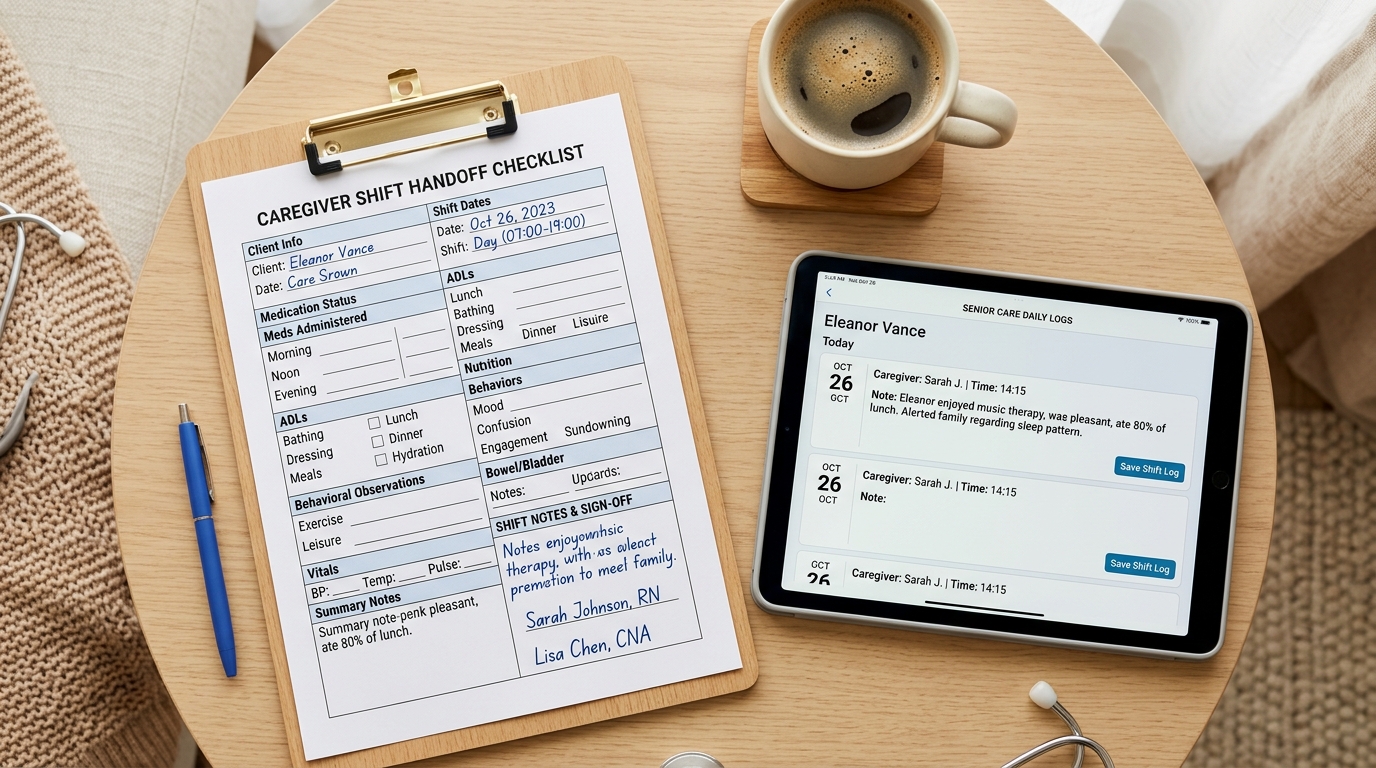
Look at the medication line in particular. It does not say "meds done." It says which doses were given, at what time, and — critically — that the 6pm dose has not been given and belongs to the person arriving. That single explicit sentence is the difference between a clean shift and a double-dosing incident.
The four fields people get wrong
1. "Good day" is not a mood report
Good compared to what? The value is in the specific and the recent. Anyone can act on "calm since 6:15, tearful around 3pm, settled after we moved to the kitchen." Nobody can act on "good day."
Useless
“She was good today. Ate fine. No problems.”
Usable
“Calm since 6:15pm. Tearful around 3, settled within 10 minutes once we moved to the kitchen. Ate half her lunch and a banana at 4.”
2. "What changed" gets skipped because nothing dramatic happened
This is the most valuable line on the page and the one most often left blank. It is not asking for emergencies. It is asking whether she was slower on the stairs, whether she needed a word she had yesterday, whether she woke twice instead of once. Individually these are noise. Recorded daily for three weeks, they are the pattern a doctor can actually use — and they are the reason a care binder with a running record beats memory every time.
Any sudden change — new confusion, a fall, a sharp drop in alertness or appetite, new incontinence — is not a handoff note. It is a same-day phone call to the doctor or nurse line. In someone with dementia these often signal an infection or another treatable problem.
3. Interventions are written once and never updated
Families write "music calms her" on a card in March and it stays on the fridge until December. But what calms someone with dementia drifts, sometimes over weeks. The handoff should carry today's working intervention, which is why it belongs on a note that gets rewritten every shift rather than laminated.
4. Nobody names the second phone number
"Call me if anything happens" fails at 11:15pm when you are asleep. Give a cutoff time and a named person who takes over after it. If you are coordinating across siblings, agree on that rotation in advance — see how to divide up care team roles.
The 90-second verbal version
The written note is the record. The spoken handoff is what actually gets absorbed. Do both, in this order, and it takes about a minute and a half.
Ask the incoming caregiver to say the medication line back to you. It feels excessive the first time and it is the single highest-value five seconds in the whole exchange.
Free shift handoff template
A one-page fillable handoff sheet with all seven fields, sized to print two-per-page so a week fits on four sheets.
- Fillable PDF and a print-and-write version
- A filled-in example page so a new aide can see the expected level of detail
- A separate night-shift variant — see what to tell the night caregiver
Doing this without paper
Paper handoffs have one structural flaw: they live in the house. The sibling who is 900 miles away never sees them, and when your mother goes to the emergency room, the notebook stays on the counter.
Care Dementia Tracker was built around this specific handoff. Each shift produces a prepared summary automatically from what was already logged during the day, so the person leaving is not writing a report from memory at 7pm. Entries carry the author's name and a timestamp, medications lock once marked given so the next caregiver cannot administer a second dose, and everything syncs to the whole care team's devices in about 200 milliseconds — including the sibling who is not in the room.
Three mistakes worth avoiding
- Writing the handoff at the end of the shift. You will compress eight hours into three vague sentences. Jot as you go and the handoff writes itself.
- Handing off only to paid caregivers. Family-to-family handoffs are usually worse, because familiarity makes people skip the basics. Your brother taking the weekend needs the same seven fields a stranger does.
- Treating the note as a performance review. If the log becomes a place where caregivers get blamed, it stops being accurate within a week. Record events, not judgments.
Common questions
How long should a caregiver handoff note take to write?
Two to three minutes if you jot notes during the shift, and ten frustrating minutes if you try to reconstruct the whole day at the door. The seven fields are deliberately short — this is a note, not a report.
What is the difference between a handoff note and a daily log?
The log is the running record of the whole day; the handoff is the summary handed to the next person. In practice the handoff is generated from the log, which is why keeping the log as you go makes the handoff nearly automatic.
Do I need a handoff note if the same two family members always trade off?
Yes, and arguably more. Familiar pairs skip the basics because both assume the other already knows, which is exactly how medication doses get missed or doubled.
What should I do if the incoming caregiver does not read the note?
Walk them through it verbally the first several times and ask them to repeat the medication line back. Once the pattern is established, most caregivers read it unprompted because it makes their shift easier.
Can a handoff note be used as a medical record?
It is not a clinical record, but a consistent dated log with named authors is genuinely useful to physicians, and families routinely bring exported summaries to neurology appointments. Ask the practice what format they prefer.
Sources
This is a documentation and coordination guide, not medical advice. It will not tell you what a symptom means or how to treat it. Any sudden change in behavior, alertness, appetite, or continence should be reported to your care recipient's doctor or nurse line the same day — sudden changes in someone with dementia can signal an infection or other treatable medical problem.