Care binders fail in a specific and predictable way. Someone builds a beautiful one in the first month after a diagnosis, everybody agrees it is a great idea, and then it sits on a shelf becoming slowly and invisibly wrong — until the night your mother goes to the emergency room and the medication list in it is nine months out of date.
A binder is not an archive. It is an operational tool that has to work in three specific moments, and it should be built backwards from those moments rather than forwards from a list of documents.
The eight tabs a dementia care binder needs
- Emergency page — one sheet, at the front, not in a pocket, grabbable in two seconds
- Medical — diagnoses, test results, specialists, appointment summaries
- Medications — current list plus the running administration sheets
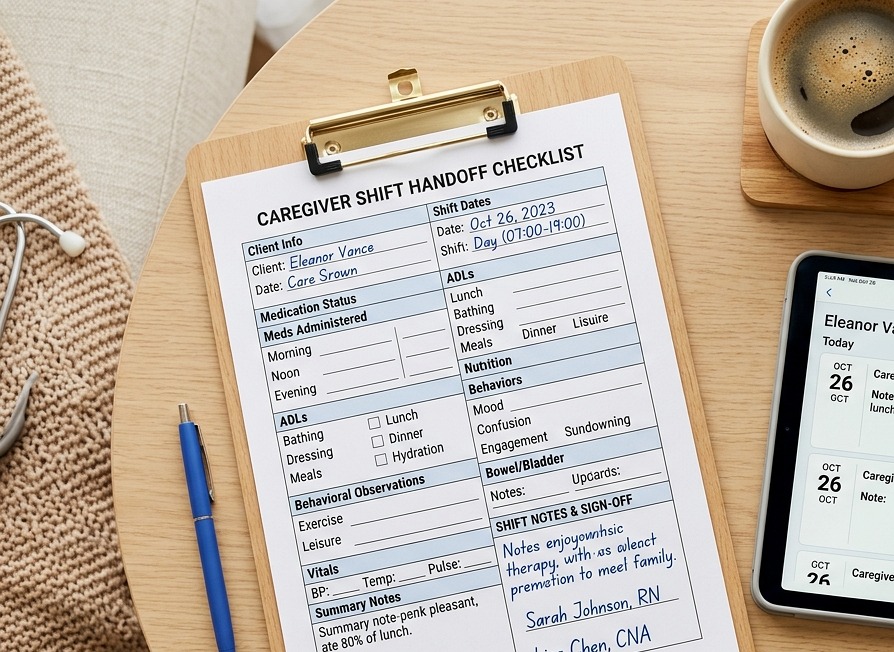
- Daily care — routine, preferences, abilities, handoff templates
- Legal — power of attorney, health care proxy, advance directive
- Financial — accounts, insurance policies, benefits, care costs
- Care team — roles chart, rotation, aide and agency details
- Records over time — weekly summaries, patterns, incidents
If you build only one thing, build the emergency page. It is the tab that gets used under the worst conditions and the one most often missing.
Build backwards from the three moments
The emergency page is not a tab
It sits loose at the very front, or in a plastic sleeve on the fridge, and it is one page. Name, date of birth, diagnoses, allergies, current medications with doses, insurance and Medicare numbers, and two contacts. At 2am somebody grabs that page and gets in the ambulance. If they have to open a binder and read a tab, the design has already failed.
Keep a photograph of it on every family member's phone. This costs nothing and it is the single highest-value thing in the whole system.
The new aide needs one tab, findable instantly
Daily care — routine, preferences, abilities, what calms and what triggers. Not the legal tab, not the financial tab. A new aide handed a full binder will read none of it; handed one tab, they will read all of it. See onboarding a home health aide for the one-page version that should live at the front of it.
The specialist wants two pages, not sixty
Bring a summary of what changed and how often, not the raw log. Many memory clinics publish guidance on what to bring — the UCSF Memory and Aging Center among them — and a concise dated summary is almost always more useful than volume.
The eight tabs
Keep the legal tab thin and current: power of attorney, health care proxy, advance directive, and the attorney's contact details. The National Institute on Aging's advance care planning and legal planning guidance is a sensible starting point if these documents do not exist yet. Do this early — capacity requirements mean some of it becomes much harder later.
What actually keeps a binder current
This is the part nobody writes about, and it is the whole difference between a useful binder and a decorative one.
- One named owner. Not the family — a person. An unowned binder is nobody's job and goes stale within a season. Put it in the roles chart with a name against it.
- Date every page. An undated medication list is worse than none, because it will be trusted. Print the date on every sheet that can change.
- Retire, do not edit. When a prescription changes, print a new sheet and move the old one to the back. Crossings-out are how binders become unreliable.
- A five-minute monthly check. Medication list, contacts, insurance details. Put it in the calendar on a fixed day.
- Update after every appointment, on the same day, while you still remember what was said.
Binder that will fail you
Beautiful, comprehensive, built once
Undated pages
Medication list edited by hand in the margins
Nobody owns it
Emergency information inside, behind a tab
Binder that works
Thin, current, one named owner
Every changeable page dated
Old sheets retired to the back, not overwritten
Five-minute check on the first of the month
Emergency page loose at the front, photographed on every phone
Paper, digital, or both
The honest answer is both, because they fail in opposite ways.
Paper is unbeatable in an emergency room, where nobody wants to watch you unlock a phone and find an app while they are trying to take a history. Paper does not run out of battery and does not need a password. But paper lives in one house — which means the sibling three states away cannot see it, and it is silently out of date the moment something changes.
Digital records solve exactly that. Care Dementia Tracker keeps the living, changing part — the medication record, the daily log, behavior patterns, who was on duty — current across every caregiver's device automatically, so there is no version of it that is nine months stale. Premium exports a clean PDF summary for a medical appointment, which covers the "two pages, not sixty" problem without anybody transcribing anything.
The practical split most families land on: the binder holds what rarely changes — legal documents, insurance policies, diagnosis letters, the routine sheet. The app holds what changes daily. And the emergency page exists in both, on paper at the front and photographed on every phone.
Where to keep it
Somewhere obvious and consistent, not a bedroom drawer. Everyone on the care team — including aides — should be told where it lives on their first day. Tell the neighbour with the spare key too; if paramedics arrive when no family member is present, the person who lets them in should be able to point at it.
Common questions
What is the most important part of a care binder?
The one-page emergency sheet at the very front — name, date of birth, diagnoses, allergies, current medications, insurance numbers and two contacts. Photograph it onto every family member's phone.
How do I stop the binder going out of date?
Give it one named owner rather than leaving it to 'the family', date every changeable page, retire old sheets instead of editing them, and do a five-minute check on a fixed day each month.
Should a care binder be paper or digital?
Both, split by how often things change. Paper holds what rarely changes — legal documents, policies, diagnosis letters. Digital holds the daily record, which is the part that goes stale and the part distant family need to see.
What should I bring to a specialist appointment?
A two-page summary of what changed and how often, not the raw log. Ask the practice what format they prefer — many memory clinics publish specific guidance on what to bring.
Where should the binder be kept?
Somewhere obvious and consistent, not a bedroom drawer. Tell everyone on the care team including aides on their first day, and tell whoever holds a spare key.
Sources
This is a documentation and coordination guide, not medical advice. It will not tell you what a symptom means or how to treat it. Any sudden change in behavior, alertness, appetite, or continence should be reported to your care recipient's doctor or nurse line the same day — sudden changes in someone with dementia can signal an infection or other treatable medical problem.