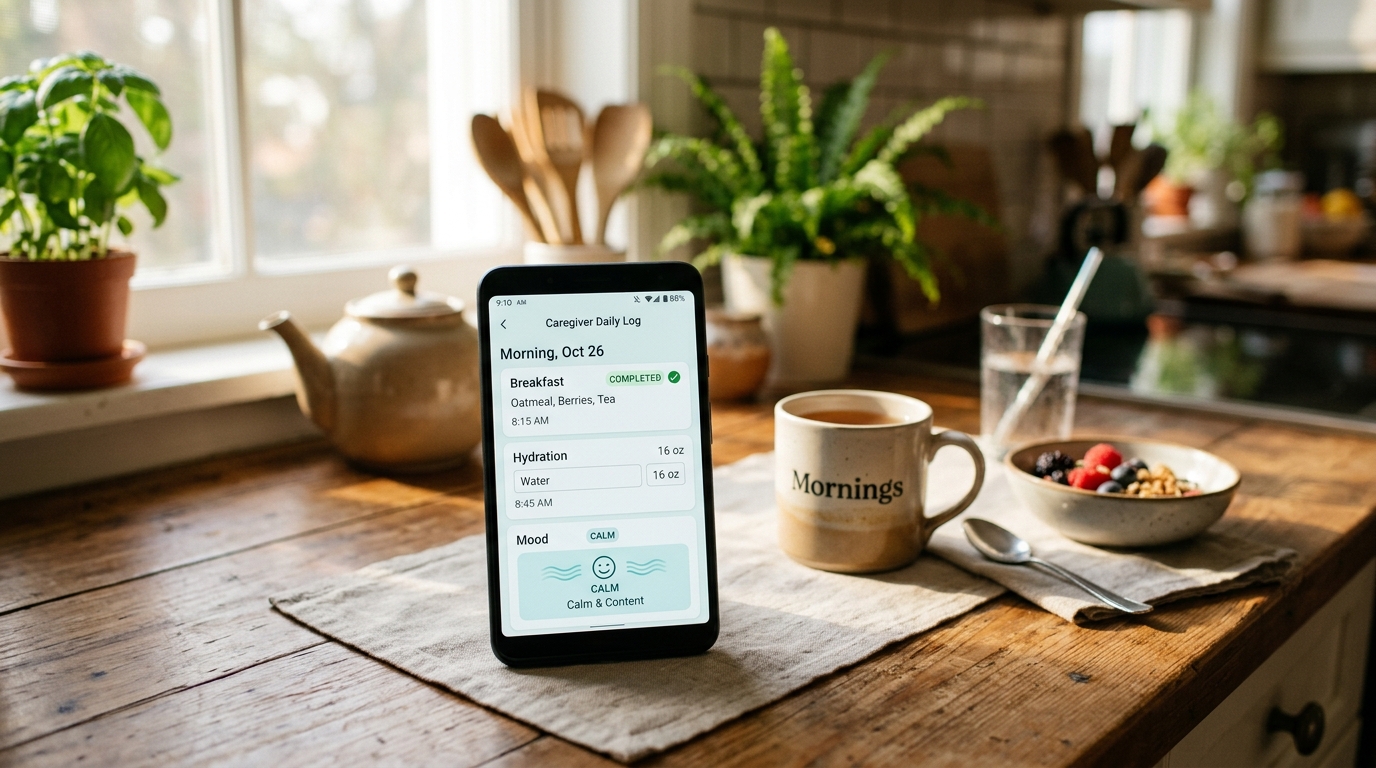
Most family caregivers start a log after a doctor's appointment goes badly. The neurologist asks how often the confusion happens, or whether the sleep problems started before the new medication, and you realize you are guessing. You have lived every one of those days and you still cannot answer, because days blur and the bad ones overwrite the ordinary ones.
A caregiver log fixes that. But most logs get abandoned inside three weeks, and almost always for the same reason: people try to write a journal instead of a record.
What a daily log entry actually needs
- A timestamp — 3:20pm, not 'this afternoon'
- The author's name — three caregivers means three sets of assumptions
- What happened, in plain observable terms — what you could have filmed
- The context around it — what was happening in the room, who was there, what had just changed
- What you did and whether it worked — including how long it took
Four to eight entries a day is a sustainable log. Twenty is a diary, and you will quit.
Write what a camera would have seen
This is the single rule that separates a log people keep from one they abandon. "Agitated" is an interpretation. "Pacing the hallway, TV news on, asking where the car keys are" is an observation. Observations are faster to write, they do not require you to be right about the cause, and they are enormously more useful to a clinician three weeks later.
It also protects the log from becoming an argument. When your brother reads "she was difficult today," he hears a judgment about the person and possibly about him. When he reads "3:20p pacing, TV news on, settled 8 minutes after moving to the kitchen," he learns a technique.
The five things worth logging every day
Resist the urge to track everything. A log with thirty fields is a log nobody fills in. These five carry nearly all the clinical and practical value:
- Medications, with times and who gave them. Non-negotiable, especially with more than one caregiver. This is the backbone of a shared medication log.
- Food and fluids, roughly. Not calories. "Half a sandwich, three glasses of water" is enough. Dehydration and gradual appetite loss are both slow and both easy to miss without a record.
- Sleep, including night waking. The most under-logged and most diagnostically useful category. Note the time up, the time back down, and what she was doing.
- Behavior events with their context. Not every mood — just the episodes, with what was happening around them.
- Anything different from yesterday. The catch-all that ends up mattering most.
A real log, filled in
Notice how little writing this actually is. The whole day is under 90 words. Notice also the last entry: "second night in a row." That phrase only exists because someone read yesterday's log before writing today's, which is the habit that turns a log into a pattern.
How to keep it going past week three
Log during, not after
Ten seconds at the moment costs less than ten minutes of reconstruction at bedtime, and it is far more accurate. If you are writing your log at 11pm, you are writing fiction.
Make it shared from day one
A log only one person maintains dies when that person has a bad week. A log three people write in survives, and it also solves a different problem — it is how long-distance siblings stay genuinely informed instead of being handled with a weekly "everything's fine."
Let bad days be short
On hard days you will write less. That is fine and expected. A three-word entry beats a skipped one, because gaps in a log are read by clinicians as "nothing happened."
If you are logging mainly to prepare for a neurology appointment, ask the practice what they want. Many memory clinics — the UCSF Memory and Aging Center among them — publish specific guidance on what to bring, and a two-page summary usually beats sixty pages of raw log.
Free daily log template with a filled-in example
A one-page daily log sheet with the five core fields, plus a completed example day so every caregiver on your team writes at the same level of detail.
- Print version and fillable PDF
- A weekly summary sheet for spotting patterns across seven days
- Pairs with the shift handoff template
When paper stops being enough
Paper works well for one household with one or two caregivers. It breaks down in three specific situations: when a caregiver is not physically present, when you need to see patterns across weeks rather than days, and when a doctor wants a summary rather than a notebook.
Care Dementia Tracker keeps the same five fields but timestamps and attributes every entry automatically, so nothing is anonymous and nothing is reconstructed. Because the whole team writes into one record, the pattern view actually works — sleep disruption over three weeks, behavior events clustered by time of day. Premium adds a PDF export formatted for a medical appointment, which is usually what a specialist wants instead of your notebook.
What not to put in a caregiver log
- Your own diagnostic conclusions. "UTI again" is a guess. "New confusion, up three times last night, stronger urine smell" is what the doctor needs. Report observations and let clinicians interpret them.
- Frustration aimed at a person. Keep that somewhere private. The moment a shared log feels like surveillance, entries get sanitized and the record loses its value.
- Everything. A log that captures every meal, mood, and remark will not survive the month. Five fields, four to eight entries, done.
Common questions
How often should I write in a caregiver log?
Four to eight short entries across the day, written as things happen. Logs written from memory at bedtime are both less accurate and much more likely to be abandoned.
What should I write when nothing happened?
One line confirming the ordinary — meds given, ate normally, slept through. Gaps in a log get read as 'nothing recorded' rather than 'nothing happened,' which weakens the record exactly when you need it.
Should the log be shared with paid caregivers?
Yes. A log only family writes in misses most of the day. Give aides access and treat their entries as equal — but never let the log be used to assign blame, or accuracy disappears within a week.
Will a doctor actually read my caregiver log?
Rarely the raw log — usually a summary. Most specialists want one or two pages covering what changed, when it started, and how often it happens. Ask the practice what they prefer before the appointment.
Is a paper log or an app better?
Paper is fine for a single household with one or two caregivers. An app becomes worth it when caregivers are not in the same place, when you need to see patterns across weeks, or when you need a doctor-ready export.
Sources
This is a documentation and coordination guide, not medical advice. It will not tell you what a symptom means or how to treat it. Any sudden change in behavior, alertness, appetite, or continence should be reported to your care recipient's doctor or nurse line the same day — sudden changes in someone with dementia can signal an infection or other treatable medical problem.