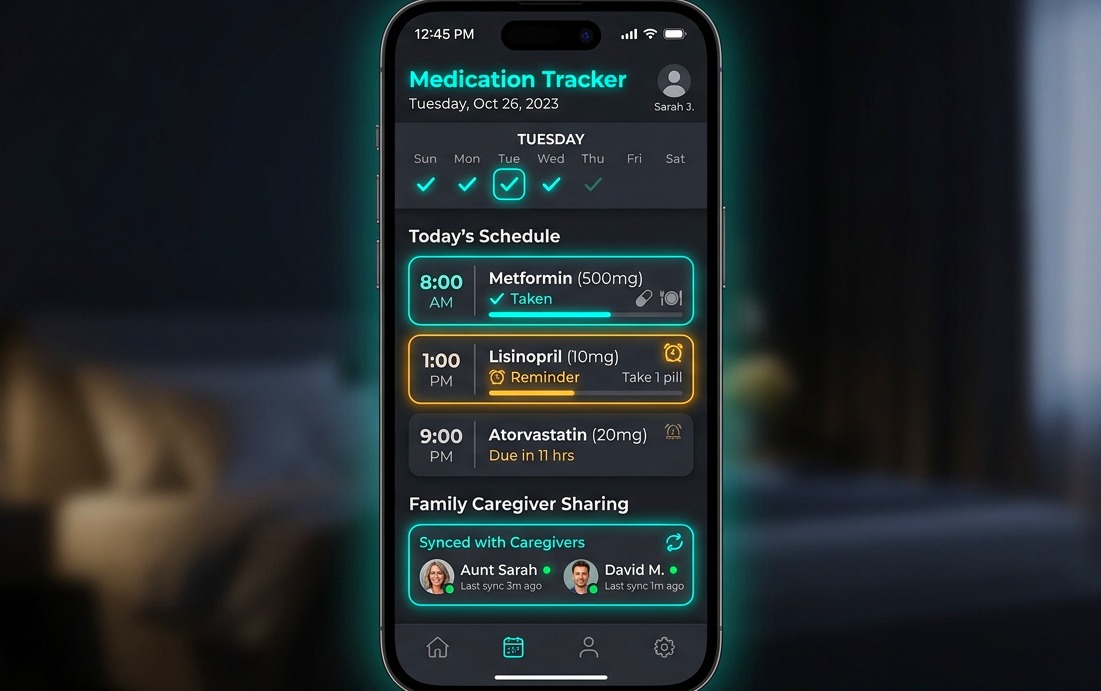
A medication log for one caregiver is a memory aid. A medication log for two or more caregivers is a safety system, and it has to be built differently — because its job is no longer helping you remember, it is telling someone else what has already happened.
That difference explains why the ordinary printable medication charts do not work well in shared households. Most of them have a tick box. A tick box tells you a dose was given. It does not tell you who gave it or when, and those two facts are the ones that matter when two people are covering the same day.
What a shared medication log must capture
- Drug, dose, and scheduled time — printed, not handwritten each week
- Exact time actually given — 6:05, not a tick
- Initials of the person who gave it — every dose has a name attached
- A visible marker for missed and refused doses — not a blank space
- As-needed doses with the reason, recorded separately from the schedule
- The date the sheet started — so a prescription change retires the sheet cleanly
A blank cell is ambiguous — it could mean not given, or given and not recorded. Every cell must end the week with something in it.
The two-signature principle
Borrowed from clinical settings and simplified for a kitchen: no dose is recorded without a name and a time. Not a tick, not a checkmark — initials and the clock.
This does two things. First, it makes the overlap window safe: at 6:15pm the incoming caregiver can see "AL 6:05" and knows with certainty the dose is done and who did it. Second, it makes the record answerable. When the neurologist asks how often the evening dose gets missed, "sometimes" becomes "twice in the last three weeks, both on Wednesdays" — which is a real finding, and probably a scheduling problem rather than a memory one.
What the sheet looks like
Three details in that grid are worth copying:
- Missed doses are written, not left blank. "MISSED" in the cell means the record is complete and the gap is real information. A blank cell means nobody knows.
- As-needed medications get their own row, below the scheduled ones, and always with a reason noted on the back. PRN doses are the easiest to double precisely because there is no schedule to check against.
- Initials appear on every single cell. Not once at the top of the column. Per dose.
Free two-signature medication log
A weekly medication grid built for households where more than one person administers, with space for initials and exact times on every dose.
- Printable weekly grid, plus a separate PRN sheet
- A one-page medication list to keep in the care binder and grab in an emergency
- A short fill-in guide for new aides — see onboarding a home health aide
Setting it up so it survives contact with real life
Print the schedule; never handwrite it weekly
Handwriting the drug list every week introduces a transcription error eventually. Print the schedule once, photocopy it, and reprint only when a prescription changes.
Retire the sheet when the prescription changes
Do not cross out and write over. Start a fresh sheet dated from the change and file the old one. A mid-week edit is exactly the sort of ambiguity that produces a wrong dose, and it also destroys your ability to answer "when did the new dose start?" later.
Keep the sheet where the medications are
Not in a binder in another room. The log has to be reachable in the same motion as the pills, or the sequence breaks and the recording stops.
Bring one page, not the binder, to appointments
Keep a current one-page medication list — drug, dose, frequency, prescriber, pharmacy, allergies — separate from the daily grid. That page goes to every appointment and every emergency room. The National Institute on Aging recommends keeping exactly this kind of consolidated list, and in an emergency it saves ten minutes of guessing.
Never adjust doses, split pills, or stop a medication based on what you see in the log, even when a pattern seems obvious. Bring the pattern to the prescriber. Some medications are genuinely dangerous to stop abruptly.
Where paper runs out
Paper does the core job well and costs nothing. It fails in three predictable places: it is only visible to whoever is standing in front of it, it cannot stop a second person from acting, and it cannot count anything for you.
Care Dementia Tracker keeps the two-signature principle and adds the thing paper structurally cannot do — once a dose is marked given, it locks, so a second caregiver cannot record or be prompted for it. Every entry carries the caregiver's name and a timestamp automatically, so nobody has to remember to initial. Adherence over weeks is countable rather than remembered, and Premium exports a clean medication summary for appointments.
Whichever you use, the underlying rule is the same and it is worth saying plainly: a dose without a name and a time attached is not recorded.
Common questions
Why initials and times instead of a tick box?
A tick tells you a dose was given but not by whom or when. With two caregivers those are the two facts that prevent a duplicate dose during shift overlap and let you answer a doctor's questions about adherence.
What should I write for a refused dose?
Write REFUSED with the time and a short note about the circumstances. A refusal is clinically meaningful information and is very different from a dose nobody remembered.
Where should the medication log be kept?
Physically with the medications, not in a binder elsewhere. If recording requires walking to another room, the recording stops within about a week.
Should as-needed medications go on the same sheet?
On the same sheet but a separate row, with the reason recorded. PRN doses are the easiest to duplicate because there is no schedule to check against.
What do I bring to the emergency room?
A current one-page medication list — drug, dose, frequency, prescriber, pharmacy and allergies — kept separately from the daily grid so you can grab it in seconds.
Sources
This is a documentation and coordination guide, not medical advice. It will not tell you what a symptom means or how to treat it. Any sudden change in behavior, alertness, appetite, or continence should be reported to your care recipient's doctor or nurse line the same day — sudden changes in someone with dementia can signal an infection or other treatable medical problem.