The new aide arrives at 9am. You have twenty minutes before you have to leave, so you show her the kitchen, point at the pill organizer, say "she can be a bit resistant about showers," and go. She is capable and kind, and the day is still going to be harder than it needed to be — for her and for your mother — because she has been handed a house and not a person.
Onboarding an aide well takes about an hour of preparation spread over a week. It is the highest return on effort available to you, because a good aide who understands the routine will hold it more consistently than the family does.
What a new aide needs on day one
- What she likes to be called, and what to call her when she is anxious
- What she can still do herself — listed before what she cannot
- How she signals distress, which is often not what you would expect
- Three things that reliably help and three that reliably do not
- The medication rules, in writing, including what to do when unsure
- Two names and numbers — one for care questions, one for scheduling and pay
Send this the day before, not at the door. An aide reading a briefing while taking off their coat retains almost none of it.
Lead with abilities, not deficits
Almost every family briefing starts with what the person cannot do. It is the wrong order, and it produces worse care. An aide who is told "she can't manage the stairs, can't work the microwave, can't be left alone" builds a picture of someone helpless and starts doing things for her that she can still do herself. Every task taken over unnecessarily is a small loss.
Lead with what she can still do and how she does it: dressing herself if the clothes are laid out in order, washing at the sink, making tea. Then note where help is needed. The Alzheimer's Association's daily care guidance emphasises exactly this — supporting remaining ability rather than substituting for it.
Briefing that produces worse care
‘She can't shower on her own.’
‘She can't follow a recipe.’
‘She gets confused in the afternoons.’
Briefing that produces better care
‘She washes at the sink independently — offer the shower, accept no.’
‘She can still peel and chop if you start it with her.’
‘Late afternoons are harder. Radio on low from about 4 helps a lot.’
The one-page briefing
The line most families leave out is the fourth one — how she signals distress. Everyone assumes distress looks like agitation. Often it looks like sudden formality, or wanting to leave, or going quiet. An aide who does not know the signal will miss the window where redirection still works, and will only notice when it has escalated.
The first three shifts
Shadow the first shift — properly
Two hours, doing the routine together, not watching from the kitchen table. Your mother's routine contains dozens of small unwritten things — which chair, which cup, which order the morning goes in — and none of them will make it onto any briefing sheet. They transfer by doing.
Leave the house on shift two
This is uncomfortable and it is necessary. Your presence changes how your mother behaves and how the aide works. You cannot evaluate a fit you are standing inside of.
Give feedback on the record, not on the person
Read what they logged and respond to that. "Can you note the time she refused the shower rather than just that she did?" is specific, unthreatening and actionable. "How's it going?" produces "fine" from everyone, forever. This is a good reason to have the log format settled before the aide starts.
Medications: be explicit on day one
Do not assume the medication system is self-evident. Written, on day one:
- Which doses are theirs to give and which are the family's
- Where the medications are, and that there is one source — not an organizer and loose bottles both in circulation
- That every dose gets initials and the exact time — see the two-signature medication log
- What to do when unsure whether a dose was given: do not give it, call
- Which as-needed medications they may give, under what circumstances, and which they may not
Say the double-dosing rule out loud on day one, before it can come up: if there is any doubt whether a dose has been given, nobody gives it until it is confirmed. Framing it as a household rule rather than a correction makes it much easier to enforce later. More on preventing double doses.
Free aide onboarding one-pager
The day-one briefing as a fillable single page, plus a first-week checklist and the three end-of-shift questions worth asking.
- One-page briefing template with all eight fields
- First-week onboarding checklist
- A shorter variant for respite and short-term cover
What to ask at the end of shift one
Three questions, every time, and mean them:
- What surprised you? This surfaces the things you have stopped noticing.
- What did I not tell you that you needed? Your briefing has gaps and only they can see them.
- What would make tomorrow easier? Aides usually have practical answers and are rarely asked.
An aide who is asked these questions on day one tends to keep volunteering information for months. One who is not, learns that their observations are not wanted.
If the aide comes through a Medicare-certified home health agency, they work to a formal plan of care and there are limits on what they can do. Ask the agency for a copy of the plan and make sure your household briefing does not contradict it — and check hours and scope up front, because families frequently expect more coverage than the benefit provides.
Giving an aide access to the record
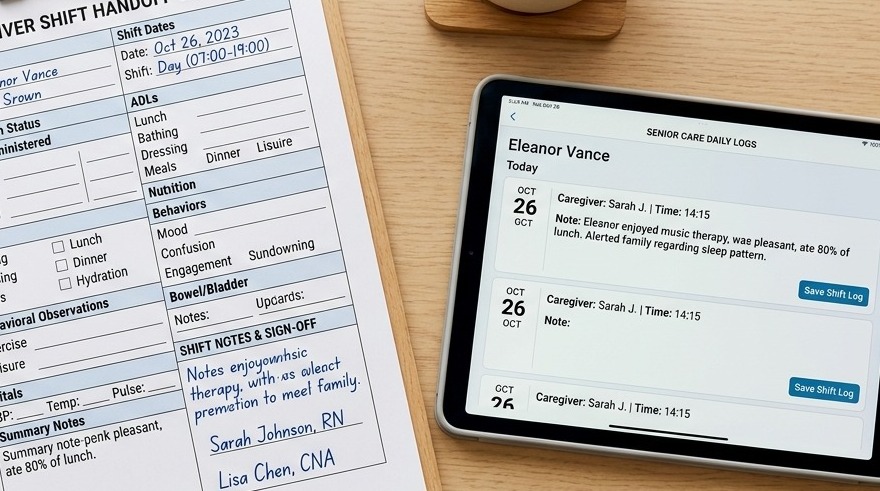
The most common mistake after onboarding is keeping the aide outside the information system — family writes in the app or notebook, the aide writes on a separate sheet, and the two never reconcile. The aide is present for more waking hours than anyone else. Their observations are the most valuable ones you have.
Care Dementia Tracker includes paid caregivers on the care team — up to five people total — with every entry carrying their name and a timestamp. The aide sees the same routine timeline the family does, marks medications given (which then lock so nobody can duplicate them), and logs behavior with its context. When they hand back to family at the end of the shift, the handoff summary is already written.
Common questions
What should I tell a new caregiver on the first day?
What your parent likes to be called, what they can still do independently, how they signal distress, three things that reliably help and three to avoid, the medication rules, and two contact numbers. One page, sent the day before.
How long does it take to onboard a home health aide?
About an hour of preparation spread across the first week, plus shadowing the first two hours of shift one. Most poor fits are visible by the third shift if you are actually checking.
Should I stay for the first shift?
Stay for the first two hours and do the routine together, then leave. Staying all day prevents you from seeing how the aide and your parent actually work together, because your presence changes both.
How do I give an aide feedback without damaging the relationship?
Respond to what they logged rather than to how the day went. Specific requests about the record are unthreatening and actionable, where general check-ins produce 'fine' from everyone indefinitely.
Should paid caregivers have access to our family care app?
Yes. The aide is present for more waking hours than anyone, so their observations are the most valuable in the record. Keeping them on a separate sheet means the two records never reconcile.
Sources
This is a documentation and coordination guide, not medical advice. It will not tell you what a symptom means or how to treat it. Any sudden change in behavior, alertness, appetite, or continence should be reported to your care recipient's doctor or nurse line the same day — sudden changes in someone with dementia can signal an infection or other treatable medical problem.