It usually happens on a good day. Your father is calm, dinner is on, your sister has come by to help, and somewhere between 5:45 and 6:30 two people who love him both give him his evening pill. Neither did anything careless. There was simply no moment at which either could have known.
Duplicate dosing is one of the most common medication errors in home care, and the risk climbs sharply the moment a second caregiver is involved. It is not a knowledge problem — everyone involved knows the schedule. It is a coordination problem, and it responds to structure rather than effort.
If a double dose has already happened, do not wait to see what develops. Call Poison Control at 1-800-222-1222 — free, confidential, staffed 24 hours — or the prescribing doctor. Have the medication bottle in hand. For trouble breathing, unresponsiveness, or seizure, call 911.
Five rules that prevent double dosing
- Log the dose before you give it, not after — interruptions happen between the two
- Assign every dose window a named owner in advance, never 'whoever is there'
- Say the medication line out loud at every handoff and have it repeated back
- Visitors do not administer medication, however helpful they are trying to be
- When in doubt, do not give it — call. A missed dose is almost always the safer error
Rule one alone eliminates the most common cause. It is also the one people resist most, because it feels backwards.
Where duplicate doses actually come from
The unlogged dose
Someone gives the 8am pill, gets interrupted before writing it down, and never comes back to the notebook. The dose happened; the record says it did not. Three hours later a second caregiver reads the record and does the responsible thing — which is the wrong thing.
This is why the order matters. Mark it, then give it. If you are interrupted after marking, the record is still accurate and the worst case is a missed dose you can verify. If you are interrupted after giving, the record is wrong and the worst case is a duplicate.
The ambiguous handoff
"Meds are done" is the single most dangerous sentence in home caregiving. Done for the morning? Done for the day? Given, or laid out? The fix is a scripted line — see what belongs in a shift handoff — that names the drug, the time, and explicitly whose the next dose is.
Ambiguous
“I gave him his meds.”
“Meds are all set.”
“He's had everything.”
Unambiguous
“8:05 donepezil given. 12:40 metformin given. The 6pm metformin has not been given — that one is yours.”
The overlap window
The highest-risk period in any household is the twenty to forty minutes when two caregivers are both present — a shift change, or a family member arriving before the aide leaves. Both are engaged, both are capable, and each reasonably assumes the other has not acted yet. Naming a single owner for each dose window removes the ambiguity entirely. If you are splitting this across siblings, settle it when you divide up caregiving duties rather than in the moment.
The helpful visitor
A brother visits, sees the organizer on the counter, notices the compartment is full, and helps. He was never part of the rota and did not know the aide had already given it from a separate blister pack. Say the rule out loud, early, and without accusation: only people on the rota touch the medications, and it is not about trust.
The protocol
Physical safeguards that actually help
- A weekly organizer with day and time compartments — an empty compartment is a visible, physical record that a notebook cannot match. Fill it once a week, the same person each time.
- One source of supply. The most dangerous setup is a pill organizer and original bottles both in circulation. Someone will eventually dose from the bottle.
- PRN medications kept separately and logged with the reason, not just the time. As-needed medications are the ones most likely to be given twice, because there is no schedule to anchor against.
- An annual medication review. Ask the prescriber or pharmacist to review the full list — the National Institute on Aging has written specifically about the risks of polypharmacy in older adults, and fewer medications means fewer chances to double one.
Ask your pharmacist about synchronizing refills and about blister or dose packaging, where each dose comes sealed and labelled with its day and time. Many pharmacies offer this at no extra cost and it makes a duplicate dose physically obvious.
Why apps handle this better than paper
Paper logs share one weakness with human memory: they only work if someone writes in them at the right moment, and they are only visible to whoever is holding them. The aide's notebook and your mother's kitchen calendar can disagree for a week before anyone notices.
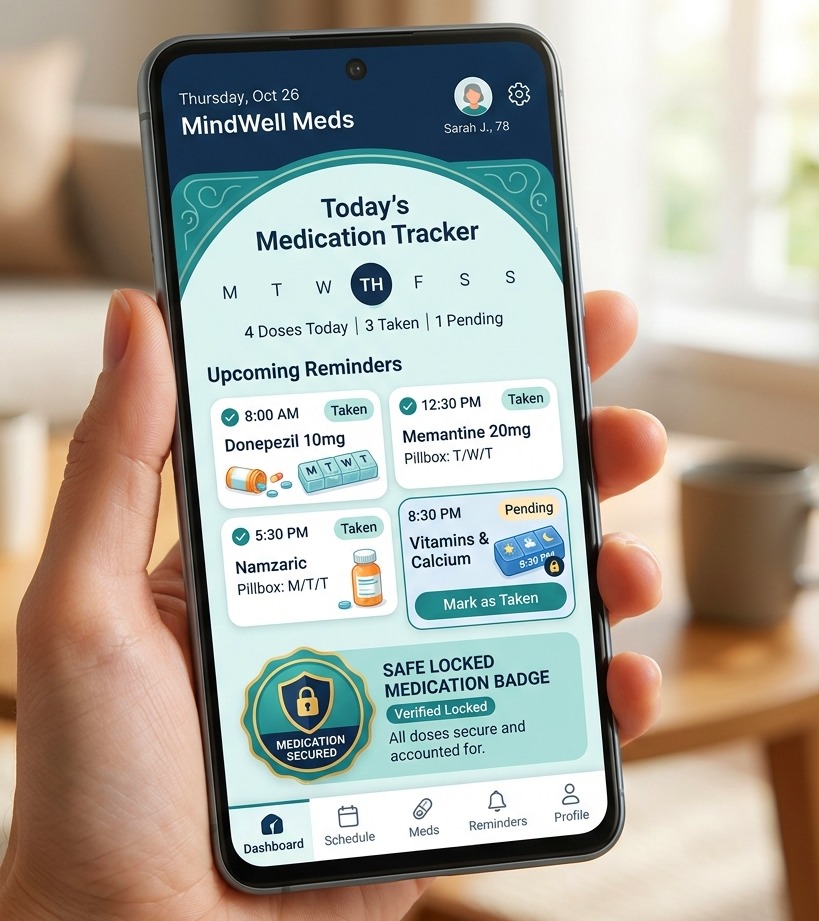
Care Dementia Tracker was built around this specific failure. When a caregiver marks a dose given, that medication locks — the next person physically cannot record or be prompted for the same dose, and they see who gave it and when. The update reaches every device on the care team in about 200 milliseconds, which matters precisely during that overlap window when two people are in the house at once. Every entry carries a name and a timestamp, so nothing is anonymous.
Pair it with a two-signature medication log for the physical side, and the two most common failure modes are both closed.
Common questions
What should I do if I think a double dose was already given?
Call Poison Control at 1-800-222-1222 or the prescribing doctor immediately, with the medication bottle in hand. Do not wait for symptoms. Call 911 for trouble breathing, unresponsiveness, or seizure.
Is it safer to skip a dose than risk giving it twice?
For most medications yes, but this depends entirely on the drug — some should never be skipped. Ask the prescriber or pharmacist to tell you, in advance, which medications on your list are which, and write the answer on the medication sheet.
Why log the dose before giving it rather than after?
Because interruptions happen between the two actions. If you are interrupted after logging, the record is accurate and you can verify a possible missed dose. If you are interrupted after giving, the record is wrong and someone may give it again.
Do pill organizers prevent double dosing?
They help a great deal, because an empty compartment is visible physical evidence. They fail when original bottles stay in circulation alongside the organizer, or when as-needed medications are stored with scheduled ones.
How do I stop a family member from giving medication without offending them?
Say it early, once, as a household rule rather than a response to something they did: only people on the medication rota administer, because doubled doses come from two helpful people, not one careless one.
Sources
This is a documentation and coordination guide, not medical advice. It will not tell you what a symptom means or how to treat it. Any sudden change in behavior, alertness, appetite, or continence should be reported to your care recipient's doctor or nurse line the same day — sudden changes in someone with dementia can signal an infection or other treatable medical problem.