The weekly call goes like this. "How's Mom?" "She's okay. Tired week." "Anything I can do?" "Not really — I've got it." Everyone hangs up, one person feeling reassured and the other feeling more alone than before the phone rang.
This is the default failure of long-distance caregiving, and it is not caused by indifference. It is caused by a bandwidth problem: the primary caregiver has no capacity to translate a week into a briefing, so they compress it into "fine" — and "fine" gives the distant sibling nothing to act on.
How to keep distant siblings genuinely informed
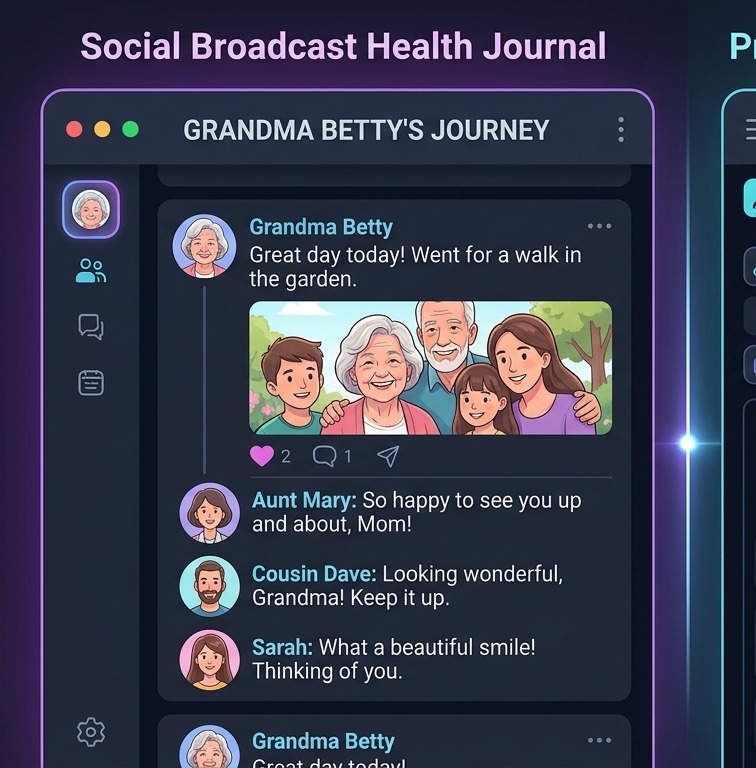
- Give them read access to the daily record, so they are not dependent on a summary
- Send a short update on a fixed day, with the same headings every week
- Always include what changed, even when nothing dramatic happened
- End every update with specific requests, named and bounded
- Say how the caregiver is doing, not just how the parent is doing
- Give distant siblings real ownership, not updates alone
Access to the record beats a better summary. A sibling who can see the last ten days does not need to be briefed on them.
Why "she's fine" happens
Writing a genuine weekly update from memory takes about forty minutes if you have not been keeping notes — you have to reconstruct the week, decide what mattered, and phrase it. The person being asked to do that is the person with the least available time in the family. So they say "fine," and mean roughly "I cannot do this right now."
Two things fix it, and only one of them is about writing. The first is keeping a running daily log, which turns the weekly update from an act of reconstruction into an act of summarising something that already exists. The second is giving distant siblings direct read access, which removes the need for a summary at all for anyone who wants detail.
The weekly update format
Same headings every time. Consistency is what makes it fast to write and fast to read, and it is what lets a reader notice a change across weeks. Fifteen minutes on a Sunday evening, not forty.
Two notes on the last two sections. "What I need" must contain named requests — "Michael: pharmacy refill by Thursday," not "if anyone has time." And "how I'm doing" is not self-indulgent. The Alzheimer's Association is clear that caregiver stress carries real health consequences; if the update never mentions the caregiver, nobody ever offers relief because nobody knows it is needed.
Give them ownership, not just information
The National Institute on Aging's long-distance caregiving guidance makes the same point: distance limits presence, not contribution. The administrative column of caregiving is substantial, invisible, and entirely location-independent — insurance appeals, benefits paperwork, appointment scheduling, supply ordering, service research. Handing all of it to a distant sibling is usually the single largest reduction in the local caregiver's load.
Involvement that does not help
Weekly ‘how is she?’ call
Offering to help ‘any time’
Researching options and emailing links
Visiting twice a year
Involvement that does
Owns insurance, bills, supplies outright
Books and confirms every appointment
Takes one full weekend per month so the primary caregiver is genuinely off
Calls the caregiver weekly, about the caregiver
Visits: make them relief, not inspection
A visiting sibling who arrives, observes, and suggests improvements does active harm. A visiting sibling who arrives and takes over so the primary caregiver leaves the house for two days is doing the most valuable thing available to them.
Before a visit, read the last two weeks of the log rather than asking to be briefed on arrival. Ask for a proper handoff the same way a paid caregiver would — the same seven fields — and give one back before you leave.
The most damaging pattern in long-distance caregiving is the sibling who visits for two days, sees a good afternoon, and concludes things are less serious than reported. Two days is not a sample. This is precisely what a dated record with several authors prevents.
Free weekly update template
The six-heading weekly update as a fillable page, sized so a whole week fits in about fifteen minutes of writing.
- Weekly update template with the six standard headings
- A pre-visit briefing sheet for the arriving sibling
- A monthly version for families who do not need weekly detail
Shared access changes the conversation
The deeper fix is structural. When every sibling can see the same record — medications given, behavior events, sleep, who was on duty — the weekly call stops being an information transfer and becomes an actual conversation. Nobody has to be believed about how hard the week was, because it is visible.
Care Dementia Tracker syncs to every caregiver's device in about 200 milliseconds, so a sibling 900 miles away sees the same day-to-day picture as the person in the house — including the ordinary days, which is what makes the hard ones legible. Up to five people on the team, and every entry carries a name and a time.
It also settles the argument nobody wants to have. When the record shows who did what and when, the question of whether the load is shared stops being a matter of anyone's word — which makes dividing duties a much shorter conversation.
Common questions
How often should I update siblings who live far away?
Weekly, on a fixed day, using the same headings each time. Consistency makes it faster to write and lets readers notice changes across weeks. Daily updates are unsustainable and monthly ones lose the detail that matters.
What can a sibling who lives far away actually do?
Own the entire administrative load — insurance, bills, benefits, supplies, appointment scheduling and service research. It is genuinely hours of work per month and needs no physical presence.
My sibling visits and thinks things are not that bad. How do I handle it?
Give them access to the dated record rather than arguing. Two days is not a sample, and a log written by several caregivers over weeks makes the pattern visible in a way that no amount of description can.
Should distant siblings see the full daily log or just a summary?
The full record, if they want it. A sibling who can read the last ten days does not need to be briefed, which removes work from the person who has the least time.
What should a visiting sibling do differently?
Take over completely so the primary caregiver actually leaves, rather than observing and suggesting. Ask for a proper handoff on arrival and give one back before leaving.
Sources
This is a documentation and coordination guide, not medical advice. It will not tell you what a symptom means or how to treat it. Any sudden change in behavior, alertness, appetite, or continence should be reported to your care recipient's doctor or nurse line the same day — sudden changes in someone with dementia can signal an infection or other treatable medical problem.