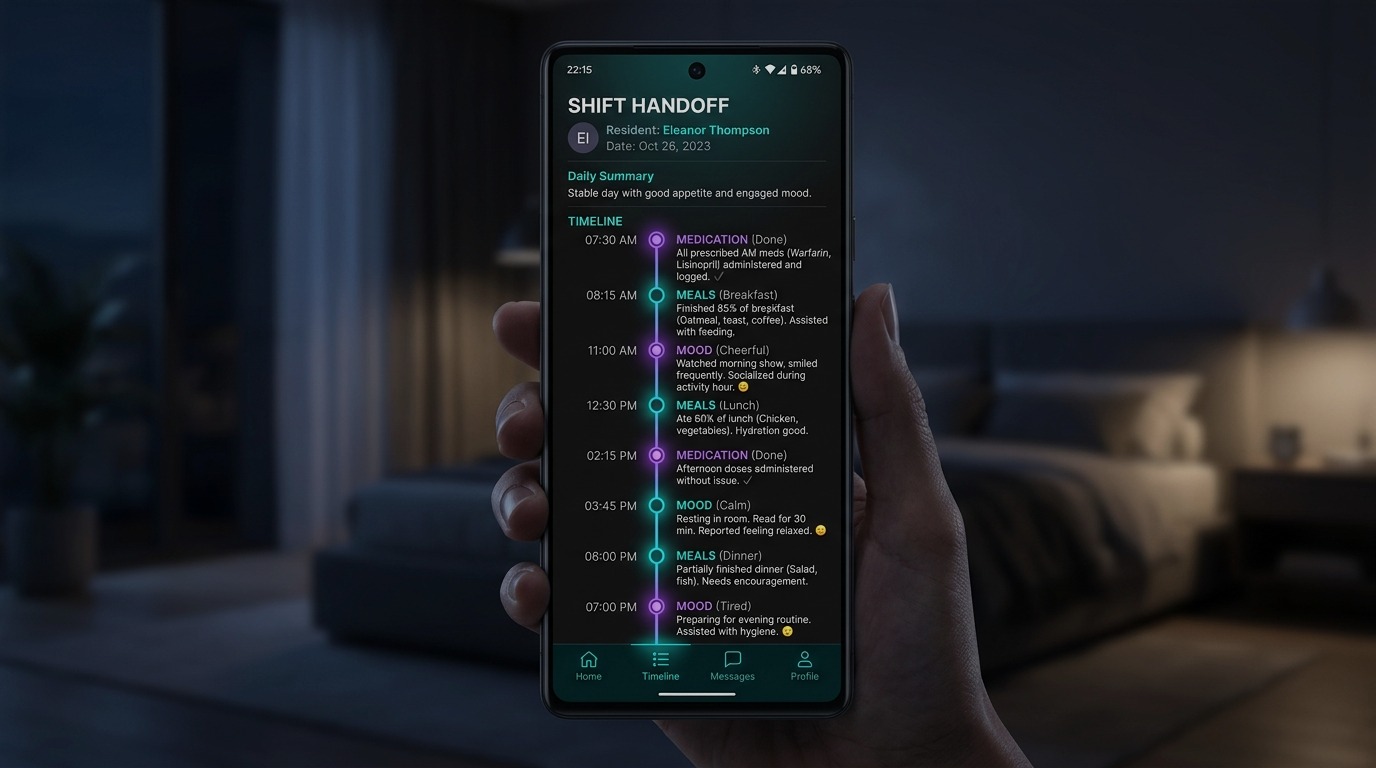
Night shifts fail differently from day shifts. During the day a caregiver who is unsure can ask, check the notebook, or call. At 3am, with a confused and frightened person in the hallway, there is no looking anything up. Whatever the night caregiver knows at 9pm is all they will have.
So the night brief is a different document from a normal shift handoff. It is shorter, it is about response rather than record, and it assumes it will be recalled under stress.
The seven lines a night caregiver needs
- The evening dose — given or not, by whom, and whether anything is due overnight
- How the evening went, because the evening usually predicts the night
- The last two nights, so tonight has a context
- Exactly what to do if she gets up — the words to use, not the principle
- What not to do, which matters more at night than during the day
- When to call you, with a genuine any-hour number
- The one thing to log — time up, time back down
Seven lines. A night brief longer than one page will not be recalled at 3am, which is the only moment it exists for.
Give the words, not the principle
This is the single biggest difference between a day brief and a night brief. During the day, "redirect her rather than correcting her" is a usable instruction. At 3am, in the dark, with someone dressed and looking for their car keys, a tired caregiver needs the actual sentence.
Principle — hard to use at 3am
‘Redirect rather than correct.’
‘Try to reorient her gently.’
‘Keep the environment calm.’
Script — usable at 3am
‘Do not say it is night. Say it's early yet.’
‘Warm milk, sit with her in the kitchen, radio off. Usually about 20 minutes.’
‘Lamp only — never the overhead light.’
Write the sentence that works in your household. Every family has one, discovered by trial, and it almost never gets written down.
The night brief
Why the last two nights matter
A single bad night is noise. Two or three in a row is a pattern worth reporting, and the night caregiver is the only person positioned to notice it. Giving them the previous nights turns them from someone getting through a shift into someone contributing to the record. It is also why the one logging instruction — time up, time back down — is worth insisting on: sleep disruption is among the most useful things a clinician can be told, and it is among the least reliably recorded.
The "do not" list matters more at night
Overhead lights, arguing about the time, and physically steering someone back to bed all escalate a situation that redirection would have resolved. These are easy to do at 3am when the caregiver is tired and wants it over. Writing them down as explicit prohibitions is more effective than any positive instruction.
Night waking that is new, or a sudden increase in night-time confusion, should be reported to the doctor rather than absorbed. In someone with dementia this can indicate an infection, pain, a medication effect, or another treatable cause. The instruction to the night caregiver is: log it and tell the family in the morning — not manage it indefinitely.
Set the evening up before you hand over
Much of what determines the night has already happened by 9pm. The Alzheimer's Association and the National Institute on Aging both cover late-day restlessness in detail; from a purely handover point of view, the practical items are:
- Lighting. Increase light in the late afternoon before dusk, then step it down gradually. A hallway night light and a bedside lamp mean nobody reaches for the overhead switch.
- The last two hours. Quiet, familiar, low-stimulus. No television news. This is part of a consistent daily routine, and the night is where its absence shows.
- Safety, checked before dark. Door alarms or chains, clear floor paths, nothing that requires solving in the dark.
- Fluids timed sensibly. Keep daytime intake up and taper in the evening, since night-time bathroom trips are a common trigger for full waking.
Free night shift brief
The seven-line night brief as a one-page fillable sheet, with a scripted response section and a simple night log for recording time up and time back down.
- One-page night brief with the scripted-response section
- A night log sheet for tracking waking across two weeks
- Pairs with the day shift handoff template
Give a real any-hour number
"Call me if you need anything" is not an instruction, and at 3am nobody uses it — the night caregiver weighs waking you against handling it alone and almost always chooses alone. Give specific triggers: a fall, an attempt to leave the house, or more than two wakings. Named triggers give permission, and permission is what actually gets used.
If you are the one being called, agree in advance who takes the second half of the night if you cannot be reached — the same on-call logic that belongs in your care team roles chart.
Making the night visible
Nights are the least-documented part of dementia care and often the most clinically informative. The person on the night shift is exhausted and least likely to write anything down, so unless logging takes seconds, it will not happen.
Care Dementia Tracker keeps the night in the same record as the day — a timestamped entry takes a few seconds on a phone in a dark hallway, and it carries the caregiver's name automatically. Over a few weeks the sleep pattern becomes visible rather than remembered, which is exactly the kind of thing worth exporting for a neurology appointment.
Common questions
What should a night caregiver be told before an overnight shift?
Whether the evening dose was given, how the evening went, what the last two nights looked like, the exact script for night waking, an explicit do-not list, when to call, and the one thing to log. Seven lines on one page.
Why write a script instead of general guidance?
At 3am, tired and dealing with a distressed person, a caregiver cannot translate a principle into words. 'Do not say it is night, say it's early yet' is usable. 'Redirect rather than correct' is not.
What should be on the do-not list for night shifts?
Overhead lights, arguing about what time it is, and physically steering someone back to bed. All three escalate situations that redirection would resolve, and all three are easy to do when tired.
What should a night caregiver record?
One thing: the time your parent got up and the time they settled again. Sleep disruption is among the most clinically useful information a caregiver can provide and among the least reliably recorded.
When should the night caregiver call the family?
Give named triggers rather than 'call if you need anything' — a fall, an attempt to leave the house, or more than two wakings. Specific triggers give permission, and permission is what actually gets used.
Sources
This is a documentation and coordination guide, not medical advice. It will not tell you what a symptom means or how to treat it. Any sudden change in behavior, alertness, appetite, or continence should be reported to your care recipient's doctor or nurse line the same day — sudden changes in someone with dementia can signal an infection or other treatable medical problem.